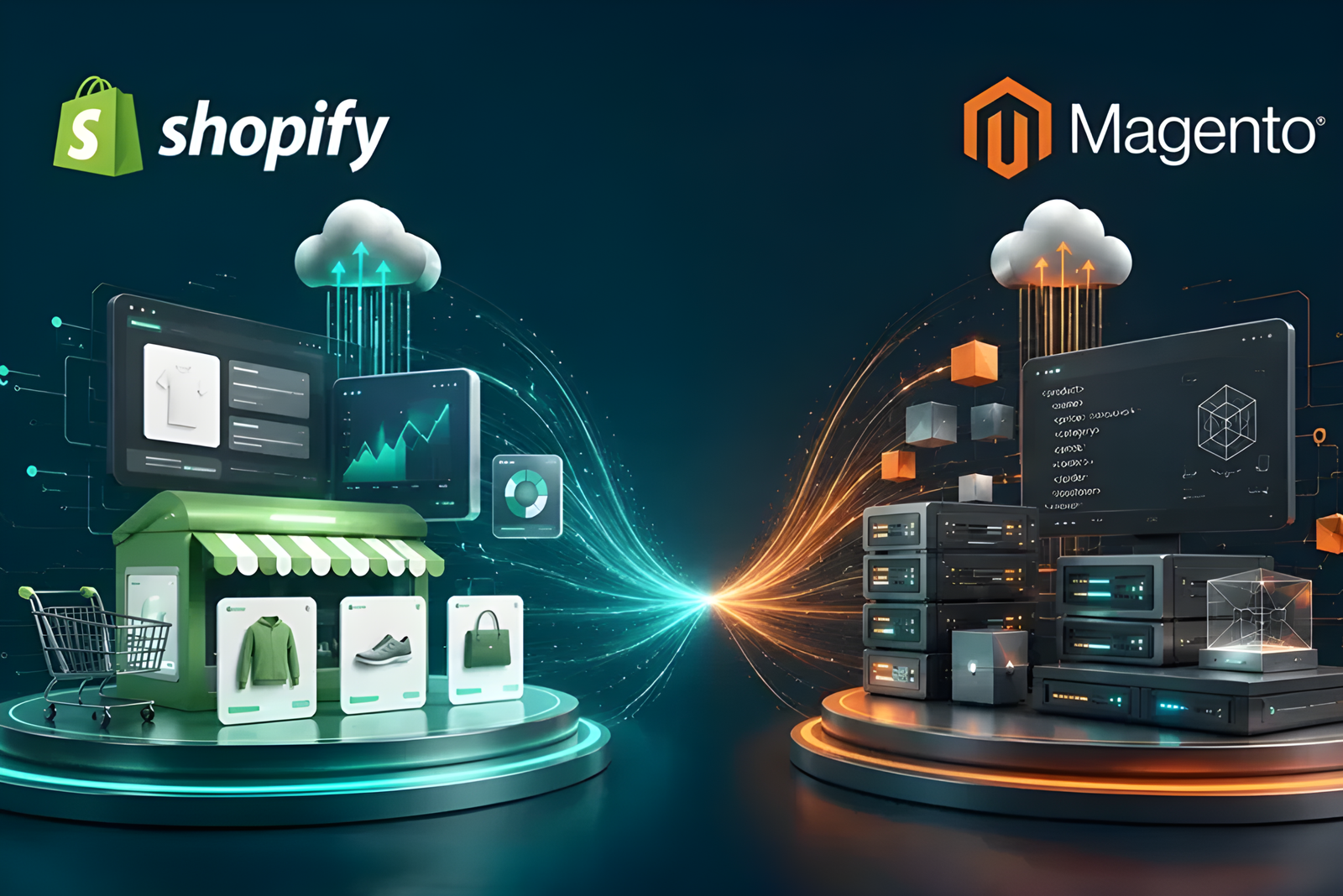
Choosing the wrong e-commerce platform is one of the most expensive mistakes a business can make — not because the initial cost is high, but because switching later is brutal. You’re migrating product data, URLs, customer records, payment integrations, and years of SEO equity. It’s a nightmare most store owners only go through once before they swear to get it right the first time.
So if you’re about to build or rebuild your online store in 2026, this guide is exactly what you need. We’re comparing the three most serious contenders — Shopify, Magento (Adobe Commerce), and Custom-built platforms — across every dimension that actually matters: cost, scalability, flexibility, SEO, and long-term ownership.
Let’s settle this properly.
Table of Contents
Why the Platform Decision Matters More Than Ever in 2026
The e-commerce landscape has shifted significantly. AI-powered product discovery, voice search, social commerce integrations, and hyper-personalised shopping experiences are no longer “future trends” — they’re present expectations. Your platform choice determines whether you can keep up with these demands or spend every quarter fighting your own tech stack.
Beyond features, Google’s ranking signals in 2026 put even greater weight on Core Web Vitals, mobile-first performance, and structured data. The platform you choose has a direct line to your search visibility — which means it has a direct line to your revenue.
This is also why working with an experienced Ecommerce Website Development partner matters at the strategy stage, not just the build stage.
Shopify: The Fastest Route to Revenue
Who It’s For
Shopify is the undisputed champion for speed to market. If you’re a D2C brand, a solo entrepreneur, a small-to-mid-size retailer, or a business that wants to sell online without becoming a technology company — Shopify is built for you.
What Works Really Well
Ease of use: Shopify’s admin dashboard is genuinely beginner-friendly. Adding products, managing inventory, setting up discounts, and processing orders requires zero technical knowledge. Your team can manage it from day one.
App ecosystem: The Shopify App Store has over 8,000 apps covering everything from email marketing and loyalty programs to AR product previews and AI-driven upsell engines. Most critical integrations exist as plug-and-play solutions.
Reliability and uptime: Shopify handles hosting, security, and infrastructure for you. During peak sale periods — Diwali, BFCM, New Year — you don’t need to worry about your server crashing under traffic spikes. That’s Shopify’s problem, and they’re very good at solving it.
Shopify Payments and multi-currency: In 2026, Shopify’s native payment infrastructure supports dozens of currencies and local payment methods, making international expansion significantly simpler.
Where Shopify Falls Short
Customisation has a ceiling. If your business model requires deeply custom checkout logic, complex B2B pricing tiers, multi-warehouse inventory routing, or a completely bespoke front-end experience — you’ll eventually hit walls. You can push through those walls with custom Shopify development, but costs climb quickly.
The other issue is data ownership and platform lock-in. Shopify owns the infrastructure. Their transaction fees (if you don’t use Shopify Payments) and monthly subscription costs compound over time. At scale, the economics shift.
Cost in India (2026)
- Shopify Basic: ~₹1,994/month (billed annually)
- Shopify Standard: ~₹5,400/month
- Shopify Advanced: ~₹21,600/month
- Custom development and theme work: ₹40,000 – ₹3,00,000+ depending on scope
Magento (Adobe Commerce): Enterprise Power, Enterprise Complexity
Who It’s For
Magento — now Adobe Commerce — is the platform of choice for large catalogues, complex business rules, and enterprises that need total control over every aspect of their online store. If you’re running a B2B wholesale operation, a multi-brand retail group, or a marketplace with thousands of SKUs and custom pricing per customer segment — Magento can handle it.
What Works Really Well
Unlimited customisation: Magento’s architecture is built for extensibility. Multi-store management, complex product attribute sets, tiered pricing, custom workflows — all of it is achievable natively or through the vast extension marketplace.
Open source roots: Magento Open Source (the free version) gives you complete ownership of your codebase. You’re not paying platform fees that scale with your revenue.
SEO control: Magento gives you granular control over URL structures, metadata, canonical tags, XML sitemaps, and structured data — important advantages for large catalogues where SEO is a primary acquisition channel.
B2B features: Adobe Commerce (the paid enterprise edition) has native B2B functionality — company accounts, quote management, purchase orders, credit limits — that would require heavy custom development on Shopify.
Where Magento Falls Short
Development complexity: Magento is not a platform you deploy yourself on a weekend. It requires experienced developers, a proper server environment, and ongoing technical maintenance. The talent pool in India is solid, but you need to verify experience carefully.
Total cost of ownership: The platform itself may be free (open source), but factor in hosting (₹20,000–₹1,50,000/year for production-grade infrastructure), developer costs, extension licenses, and security maintenance. Enterprise Adobe Commerce licensing starts at several hundred thousand rupees annually.
Speed and performance: Out of the box, Magento is heavier than Shopify. Performance optimisation requires deliberate effort — full-page caching, CDN configuration, database tuning, image optimisation pipelines. Done right, it’s fast. Done poorly, it’s painfully slow.
Custom-Built E-commerce: Maximum Control, Maximum Investment
Who It’s For
A custom e-commerce platform makes sense when your business model simply cannot be served by existing platforms. Marketplace models (think a multi-vendor platform, a rental marketplace, or a service booking + product hybrid), businesses with deeply proprietary workflows, or companies where the technology itself is the competitive moat.
What Works Really Well
Built exactly for your logic: No compromises, no workarounds, no third-party plugins holding your roadmap hostage. Every feature is designed around your specific business rules.
Performance: A lean, purpose-built application with only the features you actually use will always outperform a generalised platform with unnecessary overhead.
Ownership: You own every line of code. No platform dependency, no subscription lock-in, no surprise policy changes that affect your business.
Long-term economics: The upfront cost is high, but there are no recurring platform fees, no transaction fees, and no revenue-percentage charges. For high-GMV businesses, this matters enormously over a 5-year horizon.
Where Custom Builds Fall Short
Time and money upfront. A well-built custom e-commerce platform takes 3–9 months and costs ₹3,00,000 to ₹20,00,000+ depending on scope. You also carry the full burden of maintenance, security updates, and feature development going forward.
This is why team selection is everything. Companies like Cybernative that have a dedicated track record in custom digital product development are worth the conversation — because the difference between a well-architected custom build and a poorly architected one compounds painfully over time.
Head-to-Head Comparison: Shopify vs Magento vs Custom (2026)
| Factor | Shopify | Magento | Custom |
| Setup Speed | Fast (days–weeks) | Slow (weeks–months) | Slowest (months) |
| Upfront Cost | Low–Medium | Medium–High | High |
| Ongoing Platform Fees | Yes | Minimal (Open Source) | None |
| Customisation | Moderate | High | Unlimited |
| Technical Skill Required | Low | High | Very High |
| SEO Control | Good | Excellent | Excellent |
| Scalability | Good (to a point) | Excellent | Excellent |
| Best For | SMBs, D2C brands | Enterprise, B2B, large catalogues | Unique models, marketplaces |
The SEO Angle: Which Platform Ranks Better?
All three platforms can rank well in Google — but the effort required differs. Shopify does a lot of SEO groundwork for you (clean URLs, auto-generated sitemaps, fast CDN). Magento and custom builds require more deliberate setup but offer more control for complex SEO strategies.
In 2026, page experience signals — loading speed, interactivity, layout stability — are more heavily weighted than ever. Whichever platform you choose, investing in performance optimisation is non-negotiable.
For businesses curious about the full financial picture, understanding website cost in India across different platform types helps set realistic expectations before you engage any development team.
Industry-Specific Considerations
Not every business fits neatly into a “pick a platform” matrix. Consider that a healthcare provider building a patient portal with an integrated product store has very different compliance and functionality requirements — which is why specialized approaches like Website Development for Doctors exist as a distinct discipline, combining e-commerce capability with healthcare-specific UX and data handling requirements.
The right platform decision is always downstream of the right business and user requirements analysis.
How to Make the Final Call
Here’s a decision framework that actually works:
Choose Shopify if:
- You want to launch quickly and iterate
- Your team has no technical background
- You’re a product-based D2C brand with a clean catalogue
- Budget is a genuine constraint in year one
Choose Magento if:
- You have a large, complex catalogue (1,000+ SKUs)
- You need B2B features natively
- You have in-house or dedicated external technical resources
- You need multi-store management across brands or regions
Choose Custom if:
- Your business model doesn’t map onto existing platforms
- You’re building a marketplace or a platform product
- You have the budget and timeline to do it properly
- Long-term ownership and zero platform dependency are strategic priorities
Whichever direction you’re leaning, get the technical and strategic input of a trusted website development company in India before you commit. The build decision and the partner decision are equally important.
The Bottom Line
There is no universally correct answer to “Shopify vs Magento vs Custom.” There’s only the right answer for your business, your budget, your team’s capabilities, and your 3-year growth plan.
What separates successful e-commerce builds from expensive mistakes isn’t usually the platform — it’s the clarity of thinking that went into the decision before a single line of code was written.
Cybernative works with brands at every stage of this decision — from platform selection and architecture planning to full-scale build and post-launch growth. If you’re at the crossroads, start with a strategy conversation, not a feature comparison spreadsheet.
Because in 2026, the brands winning online aren’t necessarily the ones who chose the most popular platform. They’re the ones who chose the right one.
Ready to figure out which e-commerce platform is right for your business? Talk to Cybernative — and get a recommendation based on your goals, not a generic checklist.