Here’s a conversation that happens in boardrooms, startup offices, and WhatsApp groups with developers every single week in India:
“We need a website.” “Do you mean a website or a web app?” “…what’s the difference?”
It sounds like a pedantic developer question, but it’s actually one of the most important decisions a business makes before spending a single rupee on digital development. Getting this wrong means either massively over-investing in technology you don’t need — or under-building something that collapses the moment real users start using it.
This guide cuts through the confusion completely. By the end, you’ll know exactly what a website is, what a web app is, where the line sits between them, and — most importantly — which one your business actually needs.
Table of Contents
What Is a Website? – The Real Definition
A website is a collection of interlinked web pages hosted on a server, accessible through a browser via a domain name. Its primary job is to deliver information. The user arrives, reads, watches, or browses — but largely doesn’t interact with the content in a deeply personalised way.
Think of a website as a digital brochure, a library, or a storefront window. The visitor looks in. They don’t change what’s on display just by looking.
Common examples of websites:
- Company portfolio sites
- Blog platforms and news portals
- Restaurant menus with location and contact info
- Landing pages for products or services
- Educational resource hubs
A website built on WordPress, a clean HTML/CSS build, or a static site generator is typically serving this purpose — presenting organised, well-designed information to the right audience. A professional Website Design Development in India engagement at this level focuses on design quality, content structure, page speed, and SEO — because those are the levers that determine how well an informational website performs.
What Is a Web App? – And Why It’s Different
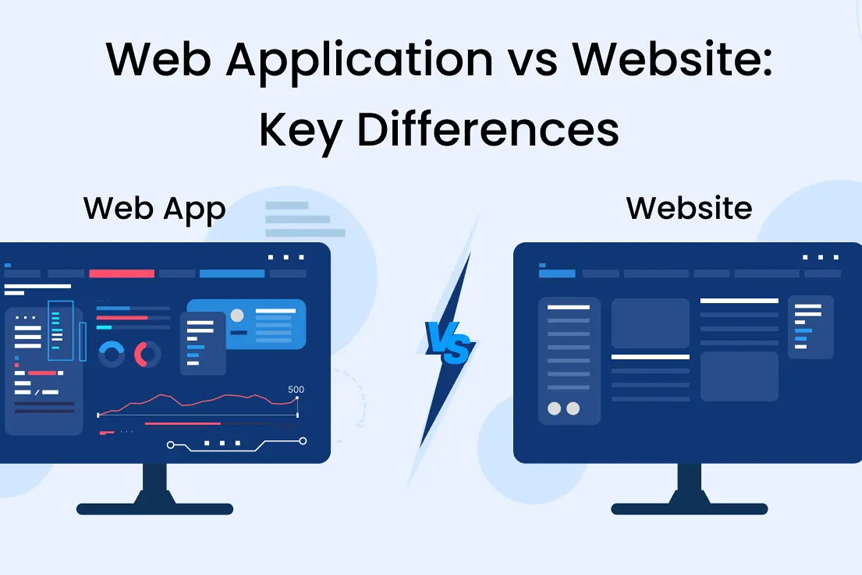
A web app is a software application that runs in a web browser. Unlike a website, a web app responds to user input and changes state. Different users see different things. Actions have consequences. Data gets created, modified, and stored.
The defining characteristic of a web app is interactivity tied to logic and data. The user isn’t just consuming content — they’re doing something, and the application responds intelligently.
Common examples of web apps:
- Online banking dashboards
- Project management tools (Trello, Asana)
- E-commerce checkout and account systems
- SaaS platforms (CRMs, ERPs, HR tools)
- Food ordering and delivery platforms
- Booking and reservation systems
- Patient portals and teleconsultation apps
When a user logs in, sees their own personalised data, takes an action, and the system updates in real time — that’s a web app. The technology stack, the development timeline, the testing requirements, and the ongoing maintenance all look fundamentally different from a standard website build.
The Grey Zone: When a Website Becomes a Web App
This is where most businesses get confused — and understandably so. Modern websites often have web app features embedded within them. A corporate website might have a live chat widget, a contact form with CRM integration, or a blog with a comment system. Does that make it a web app?
Not quite. The useful mental model is this: if the primary purpose is information delivery, it’s a website with interactive features. If the primary purpose is enabling users to accomplish tasks through the system, it’s a web app.
An e-commerce store is arguably the clearest example of the grey zone. The product catalogue pages are website-like — informational, browsable. But the cart, checkout, order tracking, account management, and inventory system are unmistakably web app territory. This is why serious e-commerce builds are treated as product engineering projects, not just design and content projects.
Web App vs Website: A Direct Comparison
| Dimension | Website | Web App |
| Primary Purpose | Deliver information | Enable user actions and tasks |
| User Interaction | Low (read/browse) | High (create, edit, transact) |
| Personalisation | Minimal | Extensive (user accounts, data) |
| Backend Complexity | Low to moderate | Moderate to very high |
| Development Time | Days to weeks | Weeks to months |
| Technology Stack | HTML/CSS, CMS (WordPress etc.) | React, Vue, Node.js, APIs, databases |
| Maintenance | Content updates, SEO | Feature development, bug fixes, scaling |
| Performance Needs | Page speed, Core Web Vitals | Uptime, concurrency, data integrity |
| Security Concerns | Standard | Authentication, data protection, encryption |
| Cost Range (India) | ₹15,000 – ₹3,00,000 | ₹1,50,000 – ₹30,00,000+ |
The Technology Decision Behind Each
Websites: CMS vs Headless
For most website builds, the content management system (CMS) is the central technology decision. WordPress dominates the Indian market and the global one — its ecosystem, talent availability, plugin library, and SEO tooling make it the default choice for most businesses.
But 2025–2026 has accelerated a real shift: headless CMS architecture is no longer just for enterprise brands. Businesses that need blazing-fast performance, multi-channel content distribution (website + mobile app + digital signage from a single content source), or more developer flexibility are increasingly choosing headless solutions like Contentful, Sanity, or Strapi over traditional monolithic CMS setups. Understanding the WordPress vs. Headless CMS tradeoff is genuinely important before you commit to a technology direction, because switching mid-project is expensive.
Web Apps: Frontend Frameworks and Backend Architecture
Web app development requires a different conversation entirely. The frontend is typically built with component-based JavaScript frameworks — React, Vue, Angular — that allow complex, reactive user interfaces. The backend handles business logic, authentication, data storage, and third-party integrations.
API-first architecture, microservices, cloud infrastructure, CI/CD pipelines, automated testing — these are normal vocabulary in web app development and they have no equivalent in a standard website project. This is why the team you choose for a web app needs to be evaluated very differently from a team you’d hire to build a marketing website.
Cost Differences: What Should You Actually Budget?
Cost is where the web app vs website distinction becomes very real for decision-makers.
A well-built informational website in India — custom design, proper SEO setup, CMS integration, performance optimised — typically runs between ₹35,000 and ₹2,00,000. The full picture of Website Cost in India across different types is worth understanding before you enter any negotiation with a vendor.
Web apps start where complex websites end. A straightforward web app with user authentication, a dashboard, basic data operations, and clean API integration might be scoped at ₹1,50,000 to ₹5,00,000. A full-scale SaaS product, marketplace, or enterprise portal? That’s a ₹10,00,000 to ₹30,00,000+ conversation with a 6–12 month timeline.
The worst outcome is budgeting for a website when you actually need a web app. The second worst is budgeting for a web app when a well-built website would have served you just as well.
How to Know Which One Your Business Needs
Answer these five questions honestly:
1. Will different users see different content based on who they are?
If yes — you need a web app (or at minimum, a website with significant app functionality).
2. Will users create, submit, or modify data through the product?
Booking appointments, placing orders, uploading files, filling in detailed forms that trigger workflows — web app territory.
3. Does your product need to work in real time?
Live chat, live tracking, instant notifications, collaborative editing — web app, without question.
4. Is the primary goal of getting found on Google and communicating your value?
If search visibility and brand credibility are the main objectives, a well-crafted website with strong SEO is exactly right.
5. Will this product become a revenue-generating tool in itself?
If the product IS the business (SaaS, marketplace, platform), you’re building a web app. If the product supports the business (marketing, lead generation, brand presence), you’re building a website.
Choosing the Right Development Partner
The distinction between a website project and a web app project has enormous implications for team selection.
For websites — especially WordPress-based builds — you need designers who understand UX, developers who are meticulous about performance and SEO, and a clear content strategy. Engaging WordPress development services in India from a team with a proven portfolio in your category is the right approach.
For web apps, the requirements shift toward software engineering rigour. You need architects who’ve designed scalable systems, frontend developers who understand state management and performance at scale, backend developers who build secure APIs, and a QA process that actually catches edge cases before users do. A reputable Web App Development Company in India brings all of these capabilities under one roof with documented process and accountability.
Cybernative operates across both disciplines — website design and development, and complex web application engineering. The advantage of working with a team that does both is that you get honest guidance on which one you actually need, rather than a vendor pushing you toward whichever service they happen to specialise in. That objectivity, early in the project, is worth an enormous amount.
Real-World Scenarios: Website or Web App?
Scenario A: A chartered accountant firm wants to attract new clients online. → Website. A clean, credibility-focused site with service pages, team profiles, client testimonials, and a contact form is exactly right. No app complexity needed.
Scenario B: A CA firm wants to build a portal where clients upload documents, track filing status, and communicate securely. → Web app. User accounts, document management, status workflows, secure messaging — this is software, not a brochure.
Scenario C: A clothing brand wants to sell online. → Both. The catalogue and brand story are website-like. The cart, checkout, order management, and customer accounts are web app functionality. This is why e-commerce is genuinely its own category.
Scenario D: A logistics company wants to let clients track shipments in real time. → Web app. Real-time data, authenticated user access, API integration with tracking systems — full app architecture required.
The Bottom Line
A website and a web app are not the same thing — and treating them as interchangeable is expensive.
Websites inform. Web apps enable. Your business almost certainly needs one more than the other right now — and the right partner will tell you which one honestly, not just quote you for whichever is more profitable to build.
The smartest digital investments in 2026 start with clarity: clarity about what you’re building, who it’s for, what it needs to do, and what “done well” actually looks like for your specific goals.
Cybernative helps businesses get to that clarity before a single line of code is written — and then builds the right thing, the right way.
Not sure whether you need a website or a web app? Start a conversation with Cybernative. You’ll leave with a clear recommendation and a realistic roadmap — whether you build with them or not.