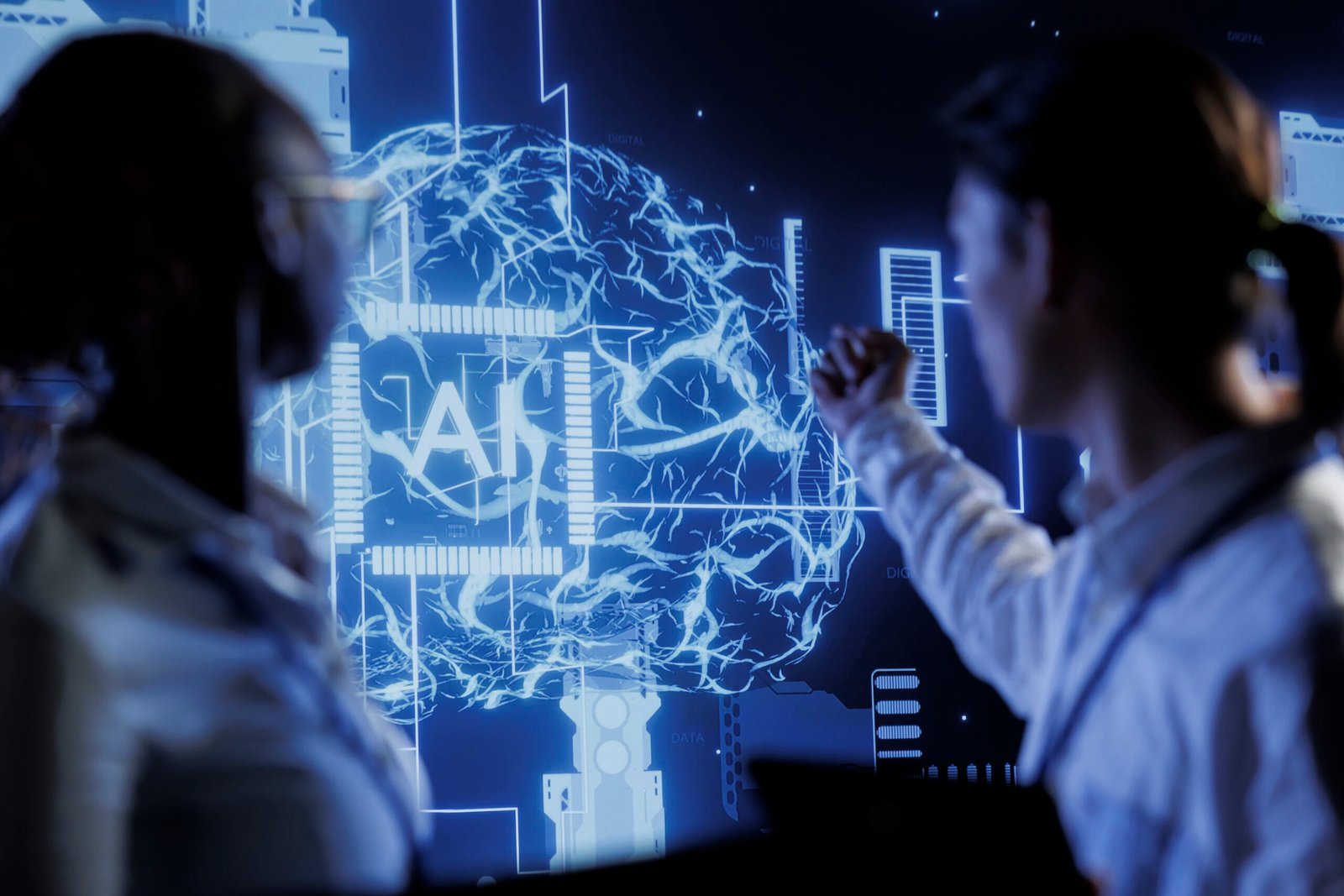
Digital transformation has moved far beyond simply replacing paper processes with software. Today, businesses are using cloud platforms, data analytics, automation, connected applications, and artificial intelligence to change how they operate and serve customers.
Among these technologies, AI is becoming one of the most important drivers of digital transformation. It can analyze large volumes of data, automate repetitive work, personalize customer experiences, support employees, and help businesses make faster decisions.
The real opportunity is not simply adding an AI chatbot to a website. Businesses are increasingly looking at how AI can become part of their wider digital strategy.
Table of Contents
What Does AI-Driven Digital Transformation Mean?
AI-driven digital transformation means using artificial intelligence as part of a company’s technology, operations, customer experience, and decision-making strategy.
Traditional digital transformation often focused on moving existing processes into digital systems. AI adds another layer of intelligence. Instead of software only storing information or following fixed instructions, AI-powered systems can analyze information, recognize patterns, generate content, make recommendations, and support complex workflows.
For example, a traditional customer service platform may record customer requests. An AI-powered platform can understand those requests, identify their intent, suggest solutions, summarize conversations, and route complex issues to the right employee.
This difference is why AI is becoming central to modern business transformation.
AI Is Changing How Businesses Make Decisions
One of the biggest benefits of AI in digital transformation is improved decision support.
Businesses generate enormous amounts of information through websites, applications, CRM systems, transactions, customer interactions, sensors, and internal operations. However, having data does not automatically mean having useful insights.
AI can process large datasets much faster than manual analysis and identify patterns that may otherwise remain hidden.
Predictive analytics can help businesses forecast demand, identify potential risks, understand customer behavior, and optimize operations. This allows decision-makers to move from simply looking at historical reports toward using data to support future-oriented decisions.
AI Is Creating Smarter Customer Experiences
Customer expectations have changed significantly. People increasingly want quick, personalized, and convenient digital experiences.
AI can help businesses respond to these expectations through intelligent recommendation systems, conversational interfaces, personalized content, automated support, and predictive customer insights.
An ecommerce business, for example, can analyze browsing and purchasing behavior to recommend relevant products. A service company can use AI to understand customer questions and provide immediate responses.
These experiences can become even more useful when AI is connected to a company’s existing customer and business data.
Generative AI Is Accelerating Digital Transformation
Generative AI has introduced a new dimension to enterprise technology.
Unlike traditional automation, which generally performs predefined tasks, generative AI can create new content such as text, summaries, code, images, and structured information.
Businesses are exploring generative AI for document analysis, marketing, software development, knowledge management, customer support, employee assistance, and research.
Companies considering generative AI development services can build applications around their own workflows rather than relying entirely on generic public AI tools.
For example, an organization can develop an internal knowledge assistant that searches approved company information and provides employees with relevant answers. This can make internal knowledge easier to access while keeping the application aligned with business requirements.
AI Is Making Business Automation More Intelligent
Automation has always been an important part of digital transformation. AI is now making automation more flexible.
Rule-based automation works well when the process is predictable. But many business activities involve emails, documents, conversations, images, and other unstructured information.
AI can help interpret this information before triggering an appropriate workflow.
For instance, an intelligent document-processing system can extract information from invoices, classify them, identify important fields, and send the data to another business system.
This combination of AI and automation can reduce repetitive work and allow employees to focus on tasks that require judgment and creativity.
AI Is Changing Software Development
Digital transformation depends heavily on software, and AI is changing how software itself is developed.
AI-assisted development tools can help developers generate code, write tests, identify potential bugs, explain existing code, and produce technical documentation.
However, AI does not eliminate the need for experienced developers. Human expertise remains important for architecture, security, business logic, testing, system integration, and quality control.
As development teams adopt AI-assisted workflows, software projects can potentially become faster and more efficient while allowing developers to spend more time solving complex problems.
AI Is Becoming Part of Industry-Specific Transformation
Every industry has different processes, customers, regulations, and operational challenges. This is why AI transformation cannot follow one universal model.
Healthcare organizations may use AI for medical workflows, document processing, and patient engagement. Financial businesses can apply AI to fraud detection, risk analysis, and customer service. Manufacturers can use predictive maintenance and computer vision.
Retail companies can focus on recommendations, demand forecasting, and customer personalization, while logistics businesses can explore route optimization and intelligent supply chain planning.
The Future of AI Development in India is closely connected to this movement toward practical, industry-specific AI applications.
Building an AI-Ready Digital Transformation Strategy
Successful AI transformation starts with business requirements rather than technology.
Companies should first identify areas where AI can solve a measurable problem. The next step is evaluating available data, existing software, infrastructure, security requirements, and integration needs.
Organizations should also decide whether they need a ready-made AI solution, an AI-powered feature within existing software, or a fully customized system.
Budget planning matters as well. AI development cost in India can vary depending on project complexity, integrations, data requirements, model selection, infrastructure, security, and ongoing maintenance.
A phased implementation is often more practical than attempting to transform every department at once. Businesses can begin with one high-value use case, measure its results, improve the system, and then expand AI adoption.
Challenges Businesses Need to Consider
AI can create significant opportunities, but implementation comes with challenges.
Data quality is one of the biggest factors. Poor or incomplete data can reduce the reliability of AI systems. Businesses also need to consider privacy, cybersecurity, model accuracy, integration with legacy applications, employee adoption, and ongoing monitoring.
These AI Development Challenges should be considered during planning rather than after deployment.
AI governance is becoming equally important. Organizations need clear policies around data usage, access permissions, human oversight, and responsible AI adoption.
The Role of AI in the Next Stage of Digital Transformation
Digital transformation is becoming less about simply adopting new software and more about creating intelligent, connected business environments.
The Top AI Trends indicate a continued shift toward AI agents, generative AI, intelligent automation, multimodal systems, predictive analytics, and personalized digital experiences.
Businesses do not need to adopt every emerging technology. The stronger approach is to understand their business objectives and select AI applications that provide measurable value.
Companies looking for guidance can work with an AI development company in India to evaluate use cases, choose suitable technologies, integrate AI with existing systems, and develop scalable solutions.
Frequently Asked Questions
1. How is AI changing digital transformation?
AI adds intelligence to digital systems by helping businesses automate processes, analyze data, personalize experiences, and support decision-making.
2. Is AI necessary for digital transformation?
Not every digital transformation project requires AI. However, AI can add significant value when businesses need advanced automation, prediction, personalization, or intelligent data analysis.
3. How does generative AI help businesses?
Generative AI can support content creation, document analysis, customer service, software development, knowledge management, and other business workflows.
4. What is the biggest challenge in AI transformation?
Data quality, security, integration, AI accuracy, employee adoption, governance, and selecting the right use case are common challenges.
5. How should a business start with AI?
Start with a specific business problem, evaluate available data and systems, choose a suitable AI approach, implement a focused use case, and measure the results before expanding.
Conclusion
AI is transforming digital transformation from a process of digitizing existing operations into a broader effort to create smarter, more responsive businesses.
Its impact can be seen across customer experience, automation, analytics, software development, decision support, and industry-specific applications. The companies that benefit most will not necessarily be those that adopt the most AI. They will be the ones that connect AI to genuine business needs.
As AI technology continues to evolve, digital transformation strategies will increasingly combine human expertise with intelligent software, reliable data, automation, and responsible AI practices.
Cybernative helps businesses explore AI and software solutions designed around practical business requirements, supporting organizations as they move toward more intelligent and