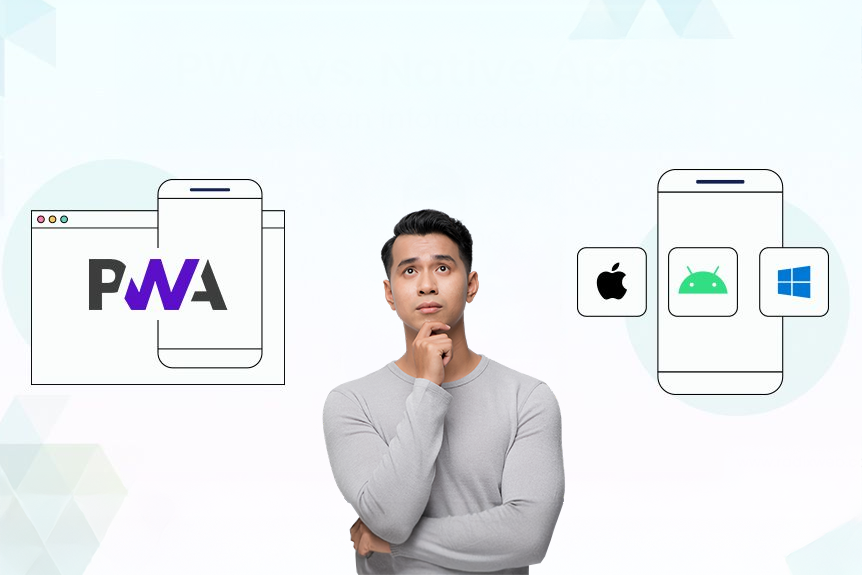
G’day! If you are sitting on a brilliant business idea in 2026, you likely know that you need a mobile presence to survive. But as soon as you start chatting with a mobile app development company in India, you will hit a fork in the road. They will ask, “Do you want to build a native app or a progressive web app (PWA)?”
For many, this is where the confusion starts. In the early days, the choice was simple. If you wanted a “real” app, you went Native. If you wanted a cheap alternative, you built a mobile website. Today, the lines are blurring. PWAs have become incredibly powerful, while Native apps have become more streamlined. Choosing the wrong one can lead to “platform regret,” spending too much money on features you don’t need, or building a light version that can’t handle your growth.
Let’s break down these two heavyweights so you can decide which path fits your budget, timeline, and users.
Table of Contents
Understanding the Basics: What’s Under the Hood?
Before we compare them, we need to know what they actually are. Think of this as choosing between a custom-built house and a high-end, modular apartment.
1. What is a native app?
If you want an iPhone app, your developers use Swift. If you want an Android app, they use Kotlin or Java. Because they are built “natively,” they live directly on the device. You find them in the Apple App Store or Google Play Store. They are the fastest, smoothest, and most powerful versions of mobile software available because they speak the phone’s language fluently.
2. What is a Progressive Web App (PWA)?
A PWA is essentially a website that has been “supercharged” to act like an app. You don’t download it from a store; you visit a URL in your browser and “add it to your home screen.” It can work offline, send push notifications, and look just like a regular app. However, it runs through the web browser engine. It’s like a website wearing a very convincing “app” costume.
When a PWA Makes Perfect Sense
Here is why you might choose this route when working with a mobile app development company in India.
1. Limited Budget and Tight Deadlines
Building a Native app usually means building two separate products: one for iOS and one for Android. That means two teams, two budgets, and two sets of bugs. A PWA uses one single code base. If you change a button’s color, it changes for everyone instantly. There is no waiting for “App Store Approval,” which can sometimes take days or weeks. If you need to launch a product in 2026 on a shoestring budget, a PWA is your best friend.
2. Content-Heavy Services and SEO
Because PWAs are web-based, search engines like Google can “read” and index them. If you are running a news portal, a recipe blog, or an educational site, you want people to find you through a Google search. With a Native app, the content is locked away inside the app. With a PWA, a user can search for a topic, click a link, and immediately be inside your app-like interface without needing to download anything. It’s the ultimate tool for organic reach.
3. Low-Frequency Use Cases
Be honest: how many apps do you have on your phone that you only use once a year? Users are suffering from “app fatigue.” They are tired of downloading 100MB files for something they will only use briefly. If you are building a mobile app for a local festival, a one-time conference, or a warranty registration portal, a PWA is perfect. The app experience is delivered to the user without the obligation of downloading, and this is much more likely to make the user actually use the app.
When a Native App is Non-Negotiable
PWAs are excellent but have a limit. Native remains the undisputed king when the power is required bare and when it is needed in a very profound level of integration.
1. High-Performance Requirements
PWAs use a browser, creating friction between the code and the hardware. When a mobile game using 3D quotes, a very powerful video-editing suite, or a high-speed stock trading application is going to be built, milliseconds count. Native applications are able to access the processor and graphics chip of the phone. This will guarantee buttery-smooth scrolling and lightning-quick response times that high-end users will desire in 2026.
2. Deep Hardware Integration
While web browsers are getting better at accessing phone features, they still can’t do everything. Native apps have the “keys to the kingdom.” If your app needs to talk to a smartwatch via Bluetooth, use advanced camera sensors for augmented reality (AR vs VR), or track GPS in the background while the phone is locked, you need a native app. For example, a fitness app that tracks your heart rate in real-time almost always needs to be native to stay reliable.
3. Security-First Applications
If you are handling sensitive data like banking, digital identity, or healthcare records, native apps offer a higher wall of protection. Native code allows developers to use advanced biometrics (like FaceID) more deeply and store data in “encrypted vaults” on the device that the browser cannot touch. If your users need to trust you with their life savings or private medical history, the “Badge of Trust” that comes with an App Store presence is invaluable.
The “India Advantage” in Development
When it comes to making this choice, many global businesses choose a mobile app development company in India. Why? Because India has one of the largest pools of developers who specialize in both worlds. Whether you need a specialist in React (the gold standard for PWAs) or a pro in Flutter and Swift (for Native), you can find world-class talent at a price point that allows you to scale. An Indian partner can frequently assist you in developing a PWA as a minimal viable product (MVP) to acquire insights on the market and subsequently assist you to pivot to native after you reach 10,000 active users.
Conclusion: Making Your Choice
So, what is the verdict?
Select a PWA when you desire to cover the largest number of persons within a minimum cost. It is suitable with a startup, content makers, and companies where the application is a helper to their primary site.
Choose a native app if your app is the product. If your business relies on high performance, complex hardware features, or top-tier security, the investment in Native development will pay for itself in user reviews and retention.
In 2026, there is no “wrong” answer, only the answer that fits your current goals.